Wednesday, May 16, 2007

Kenya - Mombasa

Located at sea level 4 degrees south of the equator, Mombasa was "Africa hot." Sitting in the shade with fans going, like I did while sipping masala tea at this cafe, you enjoy the illusory relief of waves of warm air brushing your sweaty skin, but as you an you stand up, you realize you haven't cooled off at all. In the sun, you bake.

I'm sure the temperature contributes to the languid feeling of the place, and I basically just wandered the streets enjoying the unhurried pace, the market street with lively printed fabrics hanging between cheap molded plastic household items and imported second-hand children's clothing, and the faded Indo-Arab architecture. It was safe to walk around alone, and I even hopped into a little 3-wheeled fresh air taxi when my legs had enough of strolling in the sun.

At Fort Jesus, originally part of the Portuguese trading network in East Africa, I had a very typical run-in with an African huckster. It was the low season for tourism in Mombasa, and at many moments I was the lone foreigner wandering past small stores, attracting a never-ending round of the, "Jambo, Sister, come look at my shop, look for free! Karibou!" chorus.

When I reached the fort, I paid too much for a barely-cold Fanta at a kiosk where the seller refused to tell me the price until I agreed to buy and pulled out my wallet, then I stood for a moment checking out the sign board posting entrance prices (Kenyans 100 Kenyan Shillings, East Africans 400 KSh, Others 800 KSh).

As I paused, a neat-looking gentleman in blue shirtsleeves with an official Mombasa Tour Guide badge approached me and began explaining the fee structure for the attraction (as written on the sign), the rules for taking photographs (only allowed inside, once you pay - no photographs of the outside), and the fact that you need a guide to tour the fort.

Hmmm? I was 98% it was not required to have a tour guide to visit the fort - after all, "walking tour" pamphlet was available for 100 shillings, and why would they sell that if you couldn't walk around without a guide? And none of the guide books that mentioned Fort Jesus mentioned anything about having a guide accompany you. Plus, I was 100% sure that I just wanted to walk around by myself.

He wouldn't leave my side as I approached the entrance, and when I questioned him, he repeatedly answered that I "must" have a guide. But "must" is not the same as "required" is it? So I stopped him and asked, "Are you telling me there is a rule at this fort that I cannot enter unless I have a guide?" He hesitated before squaring his shoulders and declaring, "Yes." I didn't see a way, short of physical violence, of getting him away from me, so I just turned and walked toward the ticket booth. Also, the little bit of doubt in me thought, if I do end up stuck wandering this fort with this guy, I don't really want him to be surly and angry at me.

When we got up the ramp to the entrance, he greeted the ticket seller, leaned casually on the counter, and started chatting with him like old friends. He waved his hand for me to pass him my entrance fee so he could get the ticket, but I stepped up to the counter instead. "Is it not permitted for me to enter on my own? Do I have to have a guide?" I asked. The ticket man raised an eyebrow and paused, at which point my guide straightened up and said, "Oh, no, if you don't want to do it that way, there is the pamphlet for 100 Ksh, here, pay 100, and you can walk it yourself, if that is how you want to do it. Is that what you want to do?" As if he had no idea...

Fort Jesus had beautiful views of the Indian Ocean, as did my hotel. There is a coral reef off the coast of Mombasa, and the waves break on the reef, leaving the water on the shore calm, clear, and sparkling. My dip in the Indian Ocean meant that I have now swum in 3 of the world's oceans - and I'm not planning on hitting the Arctic.

Follow the link below for more pictures of Mombasa:
Mombasa

Monday, May 14, 2007

Kenya - Nairobi

"Kairibu Kenya!" exclaimed the driver who collected me from Jomo Kenyatta International Airport, "That means welcome to Kenya."

When he pointed to the car, I immediately stepped around to the front right side and plopped myself down into... the driver's seat. Oops! Former British colony, wrong-side drive. On the drive to Melissa & Tim's house, navigating some fairly heavy traffic populated by drivers who steer their car in the same winding, fast-stop-slow-fast-slow way they might walk down a country lane while chatting with friends, I wondered a couple of times why the driver was shouting, "Use your head!" to passengers in the other cars. Then I remembered, right-hand drive - those are the drivers.

"Hakuna Matata," laughed the driver, "do you know what that means?" I hesitated. I do in fact know what that means, but wouldn't it sound condescending, or maybe just plain silly, to say, "Sure, I know your language because I heard it in a Disney movie?" So I responded in the negative, to which the driver replied, surprised, "Oh! Really? Most Americans who come to Kenya know that Kiswahili word already. It means 'no problem'."

The traffic in Nairobi's city center was pretty terrible. Beyond to the aforementioned liberal interpretation of speed and lanes, the car exhaust was overwhelming, even more so than in Beijing. As we crept past Uhuru (Freedom) Park, it occurred to me that implementing any kind of emissions limits in third-world African countries like Kenya would mean completely halting any economic progress. Not many people can afford their own automobiles, and even fewer can afford cars that are less than a decade or have any functioning emissions control system. Most people get where they need to go in old, beat-up matatus (we called them bush taxis in The Gambia), 6- to 10- passenger vans into which they cram as many people as possible. Since the drivers don't spring for seat belts, or often even new seats, it unrealistic to expect them to purchase an ecologically responsible exhaust system, the cost of which would price their taxi out of the market.

The other horrific aspect of driving safety in Nairobi is not the drivers, but the carjackers. The State Department Travel Warning for Kenya reads:

"Violent criminal attacks, including armed carjacking and home invasions/burglary, can occur at any time and in any location, and are becoming increasingly frequent, brazen, vicious, and often fatal."
I knew that, but somehow I hadn't imagined what the reality of living in such a city would be like. My first evening there, as we drove home from a friend's house - a friend who had recently convinced the men who carjacked him not to drive to his house, fearing a lethal gunfight between the carjackers and his security guards - my hosts schooled me in the best protocol for surviving such an attack. (Arms over head and shout very loud, "Whatever you want you can have. I'm unbuckling my seatbelt." Don't resist.) Another colleague was carjacked during my stay in Kenya. Even people with SUVs who live in safe neighborhoods don't visit their friends in other safe neighborhoods after dark because they aren't sure of their safety on the road between.

The effect of this stress on a diplomat's well-being and, I believe, judgment on the job, is one of those costs of Foreign Service life that are extremely difficult to calculate. US diplomatic housing compounds and many other places Westerners frequent here are certainly safe, there are many relatively safe (but not carjack-immune) places outside the capital, and a US diplomat's statistical chances of getting carjacked in Kenya still stand at less than 2%. Moreover, most carjackings are not fatal. But I can just imagine my mother's state of mind if I were living in a place where I had a 2% (and rising, unfortunately) chance of being even a not-fatal carjacking victim. I don't know how people who have spouses and children can possibly concentrate on work in such an environment. Even more amazing to me is the fact that officers remain at post, including with families, after being carjacked. This kind of threat is one thing at a danger pay or unaccompanied post, but I wonder how many Americans are aware that USG bureaucrats and their families serve under such conditions in places other than the well-known war zones and high terrorism threat countries.

One sad result of the safety situation, in my opinion, is that foreigners miss out on the local culture. My tour in The Gambia was unbelievably rewarding in large part because there was no escaping the fact of where I was. I lived in a luxurious, huge, pink house with tile floors, three balconies, a pool, a kitchen that would make any cook drool, and plenty of other amenities. As soon as I walked out of my compound, though, I was on a dirt road next door to a half-built cement house full of squatters, chickens, and trash. Gambians were highly curious about foreigners in their community and equally willing to include us in local gossip and stories, if we had the interest - which I did. It was both safe and socially acceptable to go to a "local" bar, attend a gathering at a Gambian's home, or just hang out for a long while a market stall if I happened to be there when the lunch time food bowl appeared. Without that connection to the community and constant cultural education (often more properly termed "entertainment!"), it might have been a long two years in an isolated place with only a few friends. It saddens me that some US diplomats will serve somewhere like Nairobi, where they experience a high degree of inconvenience and danger paired with very little interaction with locals, and they will likely decide not to return to Africa at all.

I do not mean to imply that my experience in Nairobi was entirely negative, nor do I want to whine on behalf of my very professional colleagues there. This introspection is completely peronsal: my tour in The Gambia was so rich and left me with such a strong desire to return to Africa, that I can't help comparing the two experiences and considering how they both will affect any future plans to work there.

As I mentioned earlier, there are safe places to go in Nairobi, and I saw a number of them. Before going to the elephant orphanage at David Sheldrick Wildlife Trust, which I mentioned in my earlier post, we stopped by the Langata Giraffe Centre. Since we had not yet been on safari, this was my first up-close experience with giraffes - and boy did we get close! Not only can you feed the giraffes, but staff encourage visitors to rest a food pellet on their upper lip and allow a giraffe "kiss" you by taking it from you with his or her tongue. On top of pictures I know she has of some of my less elegant behavior in Shanghai, Melissa now owns photographic
evidence of a female named Daisy giving me tongue. It's a good 4 years until my security clearance needs renewing...

The giraffe center had Rothschild giraffes, a different breed from the Reticulated Giraffes we would see on safari. They have different markings, but they are all beautiful creatures. For more pictures, follow the photo link below:
Nairobi 4/27- 5/4

Samburu Safari - Total Sensory Experience

Even ignoring the amazing elephants, the safari in Samburi was a veritable buffet of wildlife sights and sounds.

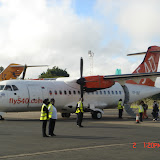
The safari adventure started at Nairobi's Wilson Airport, a small domestic airport where we were not required to show photo ID, but we did have to show proof we had paid in advance for our lodging at the safari camp. There was a metal detector, but the security guard didn't stop me from entering when I set it off. Once we climbed into the prop plane with about 6 other people, the pilot turned around and called out a request that we refrain from smoking and we remove any "sick bags" from the plane if we use them during flight. After that, we flew over the awe-inspiringly impoverished Kibera slum, passed some beautiful green hills and Mt. Kenya with enough time to get a few decent shots, and stopped briefly at an airstrip on the equator before landing in Samburu.

The airstrips at Samburu and Laikipia were just stretches of gravel with safari guides waiting in trucks alongside, and of course, all-natural "restrooms." The primitive facilities did lead Melissa, who has also worked in China, and me to marvel at the fact that a hole in the ground inside a wood shack was remarkably breathable, whereas even marble restrooms that look clean in China suffer from a persistent smell of - well, you know. Why is that? It's particularly puzzling because many such restrooms in China have a constant attendant with a mop and rag, but no matter how much they wipe, the odor remains.

The African savannah was just as you've seen it in National Geographic and Animal Planet specials, with a clear azure, almost turquoise sky providing the background for reddish-tan dirt plains, greenish brown grasses & shrubs, and flat-topped acacia trees reaching their perfectly delicate, spiny branches. Tall grass had flourished after recent rains, making us worry we'd have a hard time seeing animals, but in the end no one was able to hide from us and Charles the tenacious guide, not even the notoriously anti-social leopard.

The very first animal I saw on safari was a dikdik (above), an itty-bitty antelope or "dear-like creature (DCL)" as Melissa calls them. I won't bore you with pictures and descriptions of every DLC I saw, but this one was special because he launched my successful game-hunting experiences, so here he is. We also saw his mate, not far away because dikdiks mate for life and travel in pairs.

Surrounded by wildlife in its natural environment, you just can't help but marvel at the fact that everything in nature has a purpose. Giraffes, for instance, have antiseptic spit. Huh? Well, they eat almost exclusively those thorny acacia trees, constantly puncturing their tongues. The antibiotic properties of their saliva heal those wounds almost immediately.

And yet, with a reason for everything, there are some things that always defy explanation. One inexplicable fact is humans' willingness to kill animals like elephants, giraffes, oryx, and all the others solely for the ornamental value of their skin and appendages. On a happier note, our guide told us the improbable story of a female lion in Samburu National Reserve who adopted her prey instead of eating it. This lioness, now featured on the entrance sign that reads, "Where nature defies itself!" is apparently barren, as she has never borne her own cub. Unlike most lionesses, who stick with a pride, she seems to have always been a loner. She adopted a young oryx one year and raised it until another lion killed it when she went to drink water. She was despondent and later exhibited the same behavior toward another oryx, but game keepers this time decided to separate the pair. She continues to wander alone.
After seeing elephants, lions, giraffes, oryx, a secretary bird, guinea fowl, and countless DLCs the first and second day, the only thing left to pursue late in the afternoon our second day was the elusive leopard. Charles doubted we would find one - he pointed out that leopards surely had been watching us as we drove around the park, but they were very difficult to find; he hadn't spotted one in three weeks. As he drove us up into an area he called "leopard country," Charles said if a leopard were anywhere it would be basking on top of a rock.

We were creeping - and bumping - up a very rocky road, and Tim, Melissa, and I were dutifully scanning the boulders above, when Charles breathed, "There is the leopard." Sure enough, a leopard walked around the front tire of the truck, along the side, and leapt up top of the rock to our right, barely 10 yards away. He walked in a circle and settled down to rest and lick his fur, just like my Chinese stray, General Tsao.

We were all in awe, even Charles, and just about the only thing that would have made us more so was the appearance of another leopard - which is exactly what happened. Leopards are solo wanderers who only get together for about three days per year to mate, and we fortuitously caught this pair at exactly that time.

The leopard only rested a moment before jumping down to follow his prospective mate. We followed the white tips of their tails for a while as they disappeared into the brush up the hill. I was almost as struck by the intense interest and fascination on the part of Charles and the other guides as by the sighting itself. They ride back and forth throughout the park every day, and anything that can get them this excited is truly special.

I lack the eloquence, the energy, and the bandwidth to represent even a fraction of what we saw and heard on safari in Samburu. To see more images, follow the photo link below:

Samburu
For an even better sense of the absolutely foreign, divine sensation of waking up along the banks of the muddy Uaso Nyiro River in central Kenya, click play below to listen to the sounds that roused us before our 6:30 a.m. game ride. After listening to this, it was painful to wake to the jarring sound of Chinese talk radio on my alarm clock back in Beijing...

Sunday, May 13, 2007

Kenya - Elephants First

I know I'm not the first to say this, but I'll reinforce whatever you have heard: If you ever have the chance to go on safari in Kenya, do it.

The best thing about my trip to Kenya was seeing my friends Melissa and Tim, who took wonderful care of me and introduced me to a drink they designed themselves, which I took to calling The Smithereen. Among other things, the Brits brought Pimms to their colonies, a contribution for which all should be forever grateful.


For those who won't have the opportunity to take advantage of Tim & Melissa's friendship and hospitality, the best thing would undoubtedly be the three days we spent on safari in Samburu National Reserve.


My memory of Samburu will always be characterized by the elephants - there were so many, and they came so close to the car we could feel the breeze when the larger ones flapped their ears. We were barely inside the park when Melissa asked, "Do you have many elephants here?" Charles, our guide, had barely uttered his affirmative response when three elephants came into view munching some bushes to our right.


As we approached them, we saw about 25 more elephants frolicking - and I'm not trying to be dramatic here, they truly were frolicking, fighting, pushing, rolling around, and throwing water - in the river beyond.

Another family of elephants joined them and we watched almost 50 elephants play for about half an hour. I took the attached really shaky video of the elephants on my little handheld digital camera. It won't win any prizes for videography, but you can see the different ages and sizes of elephants and hear some of the sounds they made.


Back at camp, we played Scrabble, swam, and ate during the heat of midday, when the animals tend to hide out from the sun as well. As we wandered back from the pool toward our tents for a little siesta, Tim stopped and pointed out an elephant just on the other side of the fence. An old, solitary bull with damaged tusks seemed to enjoy grazing on the bushes just outside of our camp's swimming pool area. With damaged tusks, Charles told us, he probably would never be able to mate again, and was likely pushed out of his herd. Although elephants are social animals and like to stay in herds, the weakest and the ones who make life difficult for the rest are left behind or banished.

As I learned on the safari and at the elephant orphanage in Nairobi, elephants are extremely emotionally sensitive and have a highly developed social structure. This makes them incredibly fascinating to watch. It also makes raising elephants for re-introduction to the wild an extremely delicate process.


The David Sheldrick Wildlife Trust in Nairobi takes on this exact task, rescuing babies whose mothers have died naturally or by human hand, and training to be well-behaved elephant citizens so wild elephants will accept them into their families once they become adults. The babies and adolescents at the orphanage were charming - how can something so big with such rough skin still seem so cuddly? - and playful, but their keepers confirmed they grow up to be truly wild animals once they leave the program.


I saw lots of animals on safari in Kenya, but the elephants really blew me away - they are huge, intelligent, and personable. I doubt anything will replace the tiger as my favorite animal, or the pink flamingo as my favorite animal rendered in plastic, but the elephant has rocketed to the top of the list behind those two.

Wednesday, April 25, 2007

327 Gets His Groove Back

Regular readers will notice another lag in my blogs for the next week and a half, as I am fleeing the Chinese International Workers Day "Golden Week" and going on vacation in Kenya.

It turns out I am not the only Chinese resident seeking adventure in Africa this week: a four-year-old stud tiger from the Suzhou zoo was flown to South Africa on Monday as part of a conservation program. Although tigers are neither indigenous nor naturally present in Africa, the environment and habitat is well-suited to them. Beginning a couple of years ago, China and South Africa have been cooperating to raise a few tigers in a reserve in South Africa. The goal is for the nearly-extinct animals to breed and learn to hunt prey before being released into their natural environment in China.

The rare successful conservation story out of China always makes me smile, but I find one aspect of this story particularly entertaining, and I'm sure it says something about the cultures involved. The Chinese simply call their tiger "327", which is his breeding registration number; the South Africans, on the other hand, have given the tigers lively monikers like Madonna, Hope, and Tiger Woods. Hoping this stud will mate with a female named Cathay, they have already begun calling 327 "Boyfriend."

MiaoFeng Mountain 妙峰山

Over the last week or so, Beijing has been blessed with a string of warm, sunny, clear-for-Beijing blue sky days. Sunday was one of those amazing days, so Brendon, Ally, and I headed out to find a reported hiking spot at MiaoFeng Shan. At 1291 meters, it is the nearest 1000-meter + mountain to Beijing. I have since learned the area is known for rose bushes and a temple at the top of the mountain.

At the last stop on the subway line, "Apple Park," we found neither anything resembling and apple nor a park, but there were plenty of ruddy-faced drivers with dodgy little mini-vans eager to take us for a ride. When they told us there was no bus to our destination, we figured they were just trying to trick us into accepting their services, but after about 25 minutes of waiting, some Chinese students confirmed we really did have no choice but to hire a driver.

We hopped into the rattling silver "bread van" of a guy who didn't harass us too much but confidently proclaimed he knew where to take us to climb the mountain at MiaoFeng Shan. The scenery was pretty along the way - although the roses weren't in bloom, the hills were covered in new blossoms of some light lavender-colored flowers - but we were surprised the driver took us to the top of the mountain to begin our "climb."

When we arrived, we found the peak of MiaoFeng Shan has suffered what seems to be the fate of all Chinese scenic spots: a gate, a parking lot, a hefty 30-RMB ($3.75) entrance fee, a bunch of hawkers selling incense sticks, and a loudspeaker. Brendon observed that modern China seems to believe anything and everything can be improved by paving.

The driver was bewildered when we turned our backs on the park and struck off toward a path on the untamed slope of another peak. A few moments of explaining that we didn't come to take our picture in front of the sign on the top of the mountain, but rather to exercise and enjoy the fresh air didn't seem to clear anything up for him, until another Chinese driver in the parking lot said the magic sentence, "Foreigners are like that." Ah. Of course.

In fact, the path we found had also fairly recently been paved, we think to bring equipment to a small construction project we saw at the top. There weren't many people around, however, and the view was wonderful, so we had a really good walk.

At the top of our peak, we ran into a young Chinese group hiking with huge backpacks. They told us they were only walking for a day, but they were carrying the large packs because they were "in training." One of my Chinese teachers explained it was probably military training: first-year university students all participate in one month of compulsory military training. My teacher remembered the training was basically all physical training, without a classroom or political component. After Tiananmen Square, the requirement was one full year of military training, but it has since been reduced to one month. The purpose of the program seems to be to promote patriotism, self-discipline, and defense education. A 2005 survey by the China Youth Daily reported 69% percent of students described it as a "worthy and unforgettable experience," while 20% described it as "useless, boring, and meaningless."

We didn't take many pictures, but you can follow the link below for a few. This one shows me with the patriotic and self-disciplined Brendon Schvetz.

4/22 Miao Feng Shan Hiking

Sunday, April 22, 2007

Beijing in the Spring

I've just added to Picasa web some photos from two street corners in Beijing in March & April. The March pictures were taken near the north entrance of Workers Stadium at rush hour while the weather was still chilly.


The April pictures were taken near the gate of ChaoYang Park during late afternoon one of the first warm "blue sky" days, when everyone was out flying kites. On this day, dozens of kites added Spring color to the sky above ChaoYang Park just before the flowers and trees began to bud, while the decorations for an upcoming festival lent plenty of color to the scene on the ground.
I love the kite-flying tradition in Chinese cities. Everyone, from young children to old men, gets out there with ornately decorated kites, and they let them roam so high it's impossible to tell whose is whose; indeed, if you didn't know some of them were kites, you would assume they were high-flying hawks.

I've seen some men in the parks flying kites for hours, meticulously managing an impossibly long length of string, varying winds, and the interference of other kite-flyers.

This couple struggled to reel in their kite as it stubbornly clung to its freedom above. It took the two of them, working together, over 10 minutes to retrieve the kite from the clutches of the overhead winds.


Follow the photo link below to see more In & Around Beijing photos.
In & Around Beijing, general

15 Towers of the Great Wall

A few weeks ago, the Beijing Hikers Club did a "level 5" hike, covering 15 towers of an unrestored portion of the Great Wall outside Beijing in under 5 hours. A lot of the first half was very steep, but the real difficulty in the second half was not the physical difficulty, but the technical difficulty - we had to slide along a couple of very thin ledges and walk downhill on flat rock with no footholds. The Hikers Club had warned we might need to use ropes; we didn't, but at a couple of points I wondered, "if we don't use the ropes now, when are we going to use them?"

I must admit, most parts of the Great Wall are starting to look the same to me now (except Ningxia's mud Wall!), but the structure is so old, so huge, and so never-ending that it still takes my breath away. Follow the link below to see more photos of the hike. For those of you who are familiar with the MuTianYu portion of the Wall, you can see it in the mountains in the background of these pictures.

15 Towers of the Great Wall

Friday, April 20, 2007

Shopping in China: It's More Than Just Buying

While I was home in CT, several people commented on my super cool - if I do say so myself - eyeglasses, which I purchased here in Beijing. A great selection of frames is available at a fraction of the US price here, and most eyeglass places can reliably make lenses for almost all prescriptions.

Like everything in this super-capitalist-no-matter-what-you-want-to-call-it market, though, buying glasses definitely a BUYER BEWARE situation. Anytime you buy something of any value in China, it's essential to be very clear with the seller exactly what quality standard you're paying for and exactly what you want. For example, "I want my dress to be made of the silk that comes naturally directly from the silk worms, not from the 'man-made silk' (polyester)."

Although written, genuine guarantees and returns are unheard of, the personal relationship is king in all types of business in China. So if you develop a relationship with a vendor, you can sometimes make a promise to fix or take back an item part of your price negotiations. Of course, you had better settle this all up front before you pay, and it only works if you buy enough to make the vendor care about your business. If you haven't gotten any promises about the quality/ durability of your product, your only recourse if it turns out bad is to make a big scene and attempt to shame the vendor into helping you so the loud foreigner won't scare away other business. The efficacy of this method should not be underestimated. I had to rely on both methods the first time I purchases spectacles at a local shop in Beijing.

The shopkeeper, who lacked formal training but wore a white lab coat to prove her authority, examined my eyes using the usual eye chart method and tested several lenses until she found the ones that worked the best. It all seemed fine until I came to pick them up the next day. As soon as I donned the glasses, my left eye rebelled and fought vainly to focus, resulting in the following interaction:

ME: Oh, I'm so sorry, you'll have to re-do this lens, it's not correct.
Manager: Yes it is, I checked it myself.
ME: But I'm trying to see and it's not working. My left eye can't take it.
MGR: [taking the glasses and putting them on her own face] They look fine to me. You just don't know what it's like to have new glasses. Walk around a bit.
ME: [walking obediently] Uh, it's still not working. I see better without them.
MGR: There is no possibility they are incorrect. Your right eye is worse than your left eye, but now you're saying you don't like the prescription in your left lens.
ME: [baffled about what the heck she means] Well, this won't work. Yesterday you promised you would adjust the lens or take them back if they didn't work.
MGR: The prescription is the same as what I wrote on the slip. Wear them for a week, then if you still don't like them you can bring them back.
ME: If I wear them for a week, I'll have a terrible headache and permanent damage in my eye.
MGR: [staring at me with arms crossed, adopting the special Chinese "stonewall until the adversary gets embarrassed and walks away" approach]
ME: [staring back, thinking, "Sorry, I'm not Chinese, lady, it won't work."]
MGR: [breaking the stony silence with unassailable Chinese logic] The problem is, they are too clean. I'm sure your old glasses were dirty, but these are perfect. You're not accustomed to seeing the world in such a bright and shining way, so the colors and light are overwhelming your eyes. You have to let them adjust to this crystal clear view of everything.

A China-savvy friend with a fantastic sense of humor later pointed out I should have rubbed some dirt on the lenses then said, "Nope, still doesn't work." Unfortunately, I'm not nearly as quick on my feet as my friend Jen Christian. As I looked out the window of the shop at the "clean" and "bright" Beijing street, I really had no response.

I finally agreed to come back in a week. What? You're thinking, how could you let her beat you? But this is a Chinese negotiation, and everyone has to play their part to get the desired result.

I returned the next morning, when there were customers in the store. When I said in a loud voice, "These absolutely will not work. If I continue to wear these glasses you made me, I will go blind," the manager dutifully inserted them into a calibration machine and tested them. Of course, her machine confirmed the prescription as she intended, but I was ready with my response. "I don't care what your machine thinks, unless your machine is going to wear my glasses," I complained, looking around at the local customers who had gathered to comment on the fact that I speak Chinese. "People wear glasses, and I'm a person, and I can't wear these glasses. I might as well toss them in the trash rather than wear them and damage my eye."

With a heavy sigh, the manager agreed to re-test my eyes. During the process, the manager scolded me for answering the eye exam questions incorrectly the previous day, thereby resulting in her getting the prescription wrong. An hour later, I had a perfect pair of glasses with the correct prescription and a promise to give me a better discount if I ever go back to that shop.

I have since purchased excellent prescription eyeglasses at other places in Beijing with no hassle or confusion, but my first experience exemplified a lot of shopping situations in China. Thus, I hope you can 以小见大 "use the small to see the big" and apply the following lessons to shopping when you visit me in China.

1) Know exactly what you want, and at what price.
2) If it's expensive, get whatever promises you need before you settle on a price with the vendor.
3) If the product is not what it's supposed to be complain, remind the seller what he/she agreed, then complain loud enough to interest bystanders. (This only works if you think the bystanders will side with you, which is not usually the case at large markets, where the other vendors are in the same situation with your seller side by side every day.)
4) Don't give up. The Chinese don't take no for an answer, so neither should you. If you wait around or keep coming back, you will earn the vendor's begrudging respect and build a relationship with him or her.
5) Give the other side an "out" so the vendor doesn't have to lose face. ("You're right, of course I was the reason you gave me the wrong prescription, I must have been too tired and didn't know what I was seeing when I took the eye exam. Thank goodness I had a good night's rest last night.")

Friday, April 6, 2007

Beijing: It's Just Like Home

My hometown of Glastonbury, CT, has fairly strict planning and zoning rules, particularly with regard to signs and billboards. If I remember correctly, ours was the first McDonalds not to have those tall recognizable arches, and shortly after we moved there, the Town told a Texaco station to remove a lighted sign that could be seen for miles.

The sign below is representative of the fact that Chinese cities have no such qualms about huge, splashy, neon advertisements.No qualms, that is, until the wind came along. You see, last week, we Beijingers were promised a huge sandstorm, which would have made an excellent topic for a blog. Instead, the wind came without bringing much sand. No pictures of taxis covered in yellow Gobi dust, just gusts of grimy Beijing air cutting my delicate skin.

I thought wind was too ordinary a topic for a blog, but then again, nothing in China is ordinary. It turns out, the wind blew over many large billboards, one of which fell on woman and, sadly, killed her. The city has now decreed that all billboards on the top of residential buildings within the city must be removed by the end of June. CCTV claims as many 23 billboards will have to come down inside the Third Ring Road, which makes me think they are defining both billboards and residential buildings very narrowly - I could point to 23 signs on the tops of buildings from almost any corner inside the 3rd Ring!

So once again, I feel fortunate to have moved here in time to see the supposedly offensive advertising eyesores before they get torn down at the behest of the local authorities.